

Parenting by Subtraction
Resisting the urge to crack the shell

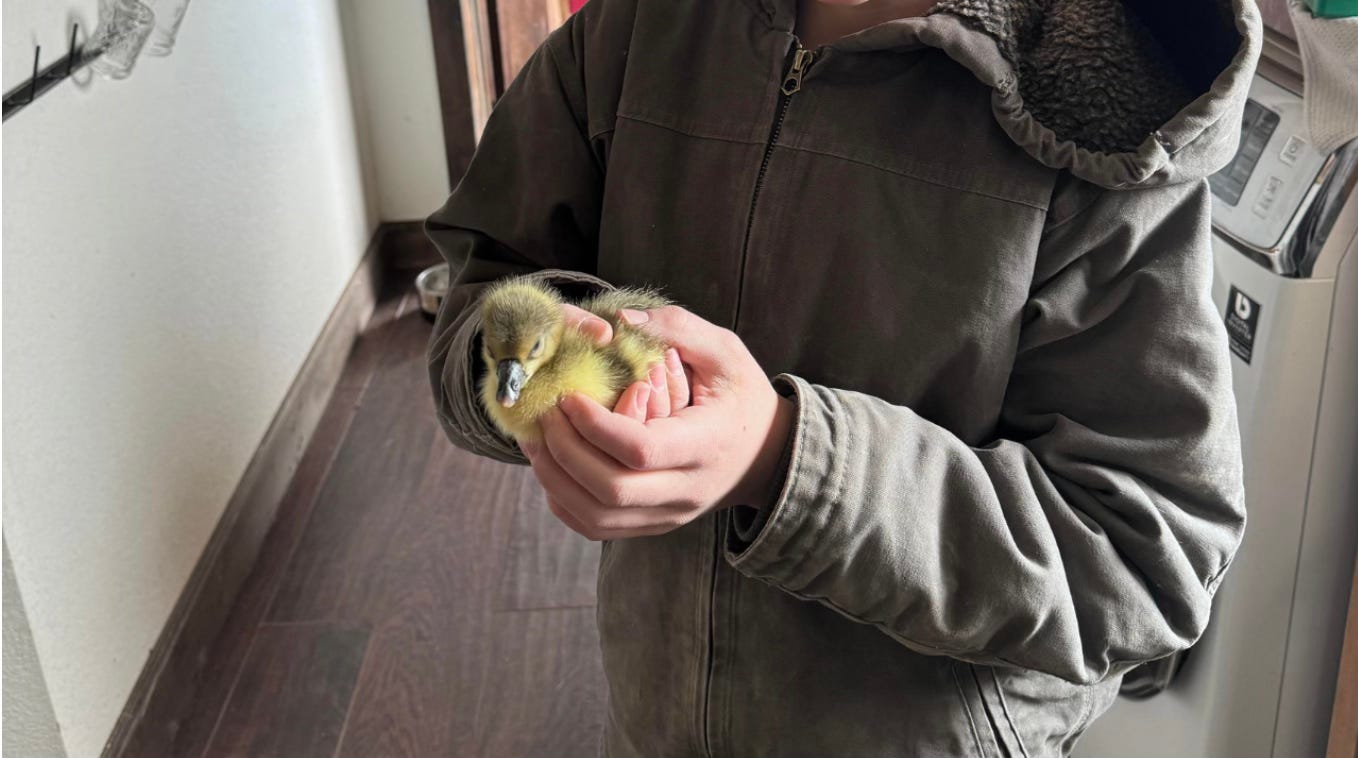
(This is a post from my blog archives. I wrote it a couple years ago and thought it was worth a reshare.)
“Are you SURE we can’t help it??”
My son peered into the incubator, eyes wide, as a tiny beak worked at a pea-sized hole in the shell.
This whole project started three weeks earlier, when my two youngest carried four goose eggs into the house with that look kids get when they’ve already decided the answer is yes.
“Pleeeeeease, Mom… can we incubate them?”
Our female goose had built a half-hearted nest before concluding she’d rather spend her days cavorting with her boyfriend. The kids had been watching the situation for days, and finally scooped up the abandoned eggs.
I hesitated.
I doubted the eggs were viable, not to mention that waterfowl eggs are tricky to incubate. We hadn’t hatched poultry in years, which meant I was rusty on the logistics. And per usual, I was juggling 17 other things and didn’t have the bandwidth to re-learn incubation from scratch.
But the puppy-dog eyes were intense, so I made a deal.
“You can incubate the eggs,” I said. “But it will be your project. You’ll have to figure out how to run the incubator, how to candle the eggs, and how to monitor humidity and temperature.”
And…” I added ominously, “There’s a good chance they won’t hatch. Are you ready to handle that?”
They vigorously agreed.
And they handled it.
My son read the incubator manual like it was a college assignment. He set up the auto-turner, replaced the batteries in the hygrometer, and obsessively monitored the temperature and humidity.
He watched Youtube videos to learn how to candle eggs, and marked dates on the calendar to assess progress. (He discarded two that stopped developing.) As we inched closer to our estimated hatch day, he locked down the incubator and prepared for hatching.
As we got closer to the big day, he locked down the incubator and prepared for the final stretch.
I braced the kids for the possibility that neither egg would hatch.
And I was wrong.
That morning, squeals of joy rang through the house.
Goose egg #1 had a crack. Hatching had commenced.
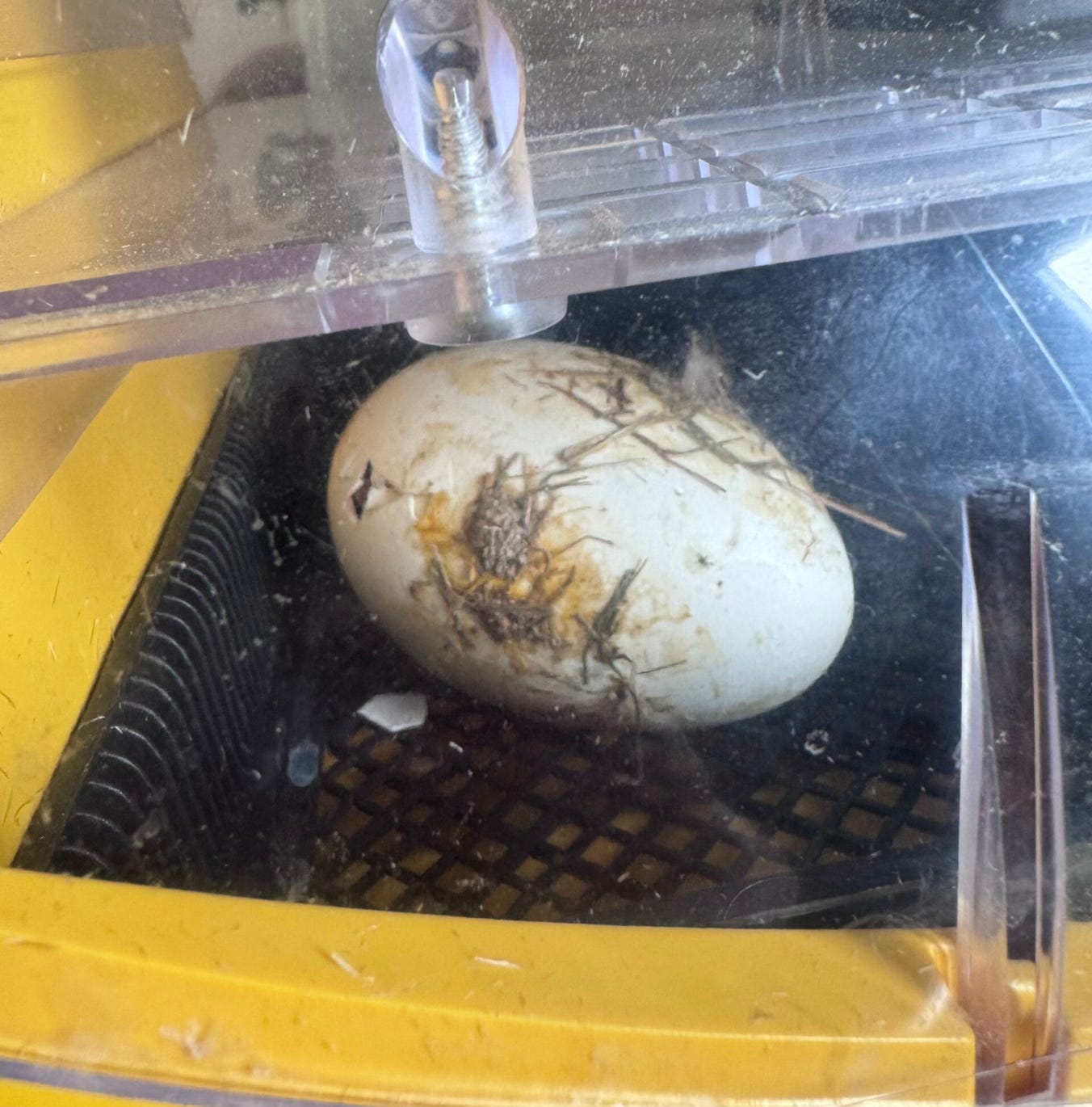
The kids set up camp next to the incubator and watched it like it was Netflix.
It’s hard to resist helping birds hatch. Our empathy kicks in and we can’t help but think of this helpless baby in an alien world, expending SO much effort to get through the shell. I could see the concern plastered on my son’s face as the hours passed and the gosling made little progress.
It was killing him to be a passive spectator.
It was taking everything he had not to open the incubator and assist the tiny beak in breaking through the shell. And if I’m being honest, I was feeling the same way.
”We can’t help it,” I explained to him (and myself, too). “The gosling needs to struggle a bit. If we rush in too soon, we’ll ruin its chance for survival.”
Turns out, this principle also applies to parenting.
When we make the path too easy for our kids, we don’t actually protect them—we weaken them. We crack the shell before they’ve built the strength to live outside it.
This is something that fascinated me when I wrote Old-Fashioned on Purpose, and it’s only become more true to me since then. Modern parenting culture tells us that good parents remove all roadblocks, smooth all paths, and never allow kids to feel discomfort, frustration, or pain.
But it’s the opposite dynamic (within wise, age-appropriate boundaries, of course) that forms the most capable adults.
In her book Bad Therapy: Why the Kids Aren’t Growing Up, Abigail Shrier argues that resilience—not fragility—is the norm for kids. They are far more able than we give them credit for. And when we step back and let them figure things out, they grow by leaps and bounds.
If I had micromanaged the hatching project in an effort to guarantee success (and prevent potential heartbreak), I would have robbed my son.
Not only would he have missed the knowledge he gained (he now understands hygrometers better than I do), but I would have stolen the joy and confidence he felt the first time he held the gosling in his hands and knew that he EARNED that his victory.
That difference is massive.
And that simple shift transformed a basic biology concept into a life lesson that’s more than the sum of its parts.
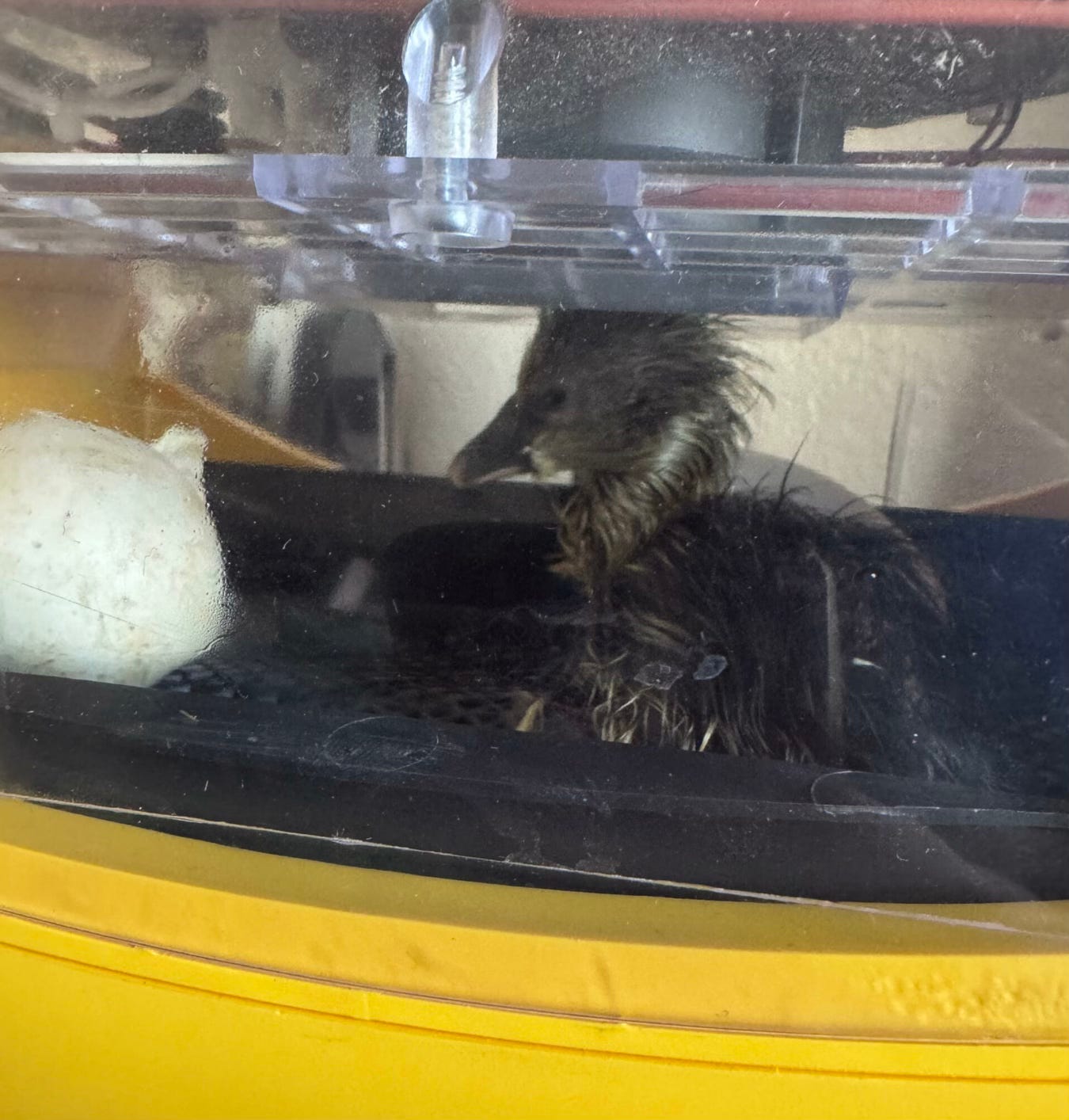
Make no mistake– it made me anxious to think about how upset he’d be if the goslings died… just like it made him anxious to watch the baby struggle to break from the shell.
But both struggles were necessary for a strong, healthy result.
And he and I both had to step back and let it happen.
Toward the end of her book, Shrier concludes that “parenting by subtraction” is the only path forward in a well-meaning world that is accidentally stunting its offspring.
And how do we apply this?
If we want resilient kids that hatch into capable, well-adjusted adults, we must do less.
We must make room for more autonomy, more mistakes, and more healthy struggle.
It seems to be the secret sauce for kids and goslings alike.
Long story short— both eggs hatched, despite my initial pessimism. We ended up helping the first egg after about 36 hours. Our incubator does a poor job of maintaining proper humidity and the gosling needed help working through the leathery membrane. But I’m glad we waited, as jumping in too early would have been disastrous (even though we were very, very tempted).
My kids were over the moon and SO proud of themselves. My son walked on air for at least 24 hours and kept repeating, “I can’t believe I did it all by myself!”
He’s already collecting eggs for his next hatch.
Parenting by subtraction,
—Jill
P.S. Bad Therapy is an excellent read. I highly recommend it. And the hardcover version of my book (Old-Fashioned on Purpose) is only $10 on Amazon right now.
P.P.S. Please don’t ask me questions about hatching, because I’m the furthest thing from a hatching expert that you can get. However, in our research we learned most eggs don’t need help, especially in proper conditions. Our equipment shortcomings complicated things. If you’ve got an incubator running for the first time: err on the side of waiting, not helping.
I remember one time I had a neighbor's kids over visiting, and a baby sparrow fell out of the nest and into the swimming pool. I told the kids to stay put.
I got the dip net, and very carefully lifted the sparrow out of the water and set it on the patio near the pool, taking great care NOT to touch it.
A few minutes later, the baby was surrounded by three or four adult sparrows, and they were cheeping and fluttering their wings at it. The baby was fluttering, too, but could not get airborne.
After about ten minutes, the adult sparrows attacked the baby, pecking it to death. The kids were aghast..."Pops! Why didn't you stop them?"
"It wasn't my place to stop them. They know what's best for their community."
After a few minutes, I went and disposed of the dead bird. The kids were silent, and then went home to rat me out to their parents for being a heartless old man.
You can't interfere with nature. If the baby bird had been meant to survive, it would've found the strength to fly. The adult birds were doing what they needed to do to protect the community.
And if I HAD interfered, the baby bird would've imprinted on me, and I would've been responsible for teaching it how to be a bird. Sorry. Not going to happen. If it had been a raptor or an endangered species, I MIGHT have tried.
This is well said.
With (much of) modern parenting, independence is (also) highly valued, but I think the difference in what you're describing is readiness. They have to be ready to really do the thing, and then you have to let go.
When we attempt to "let go" in settings that they are not ready for -- that require more patience and strength of character than they are likely to be capable of -- it leads to that pattern of rescue common to so many parents. I think early education is a major culprit here, and a focus on surface-level achievement. Parents are much more inclined to push a child into something they can't do themselves (and fake it when they fail) when there's such a tremendous fear of falling behind in schooling. It's a silly example, but I always think of the handprint turkeys in grade school. Kindergarteners "make" these, but often the teachers are managing every step of the process, rescuing the kid who can't cut with the scissors, or the one who can't trace their hand. The point is to produce something that looks finished and done regardless of whether the kid could actually do the thing. I think this too is a form of picking the shell off of the hatching gosling.
With my daughter I am careful to resist the tendency to interfere in her drawings and paintings, save for things involving safety. She's never made a preschool style craft, but her drawings show a kind of wild creativity and skill that I know is all her own. I think parents have to really resist a lot of society's values to let their children's gifts shine. Learning requires some degree of frustration and failure. We have to let them experience that and resist the urge to fake it.