

Silos
On the quiet rebellion of the messy middle....

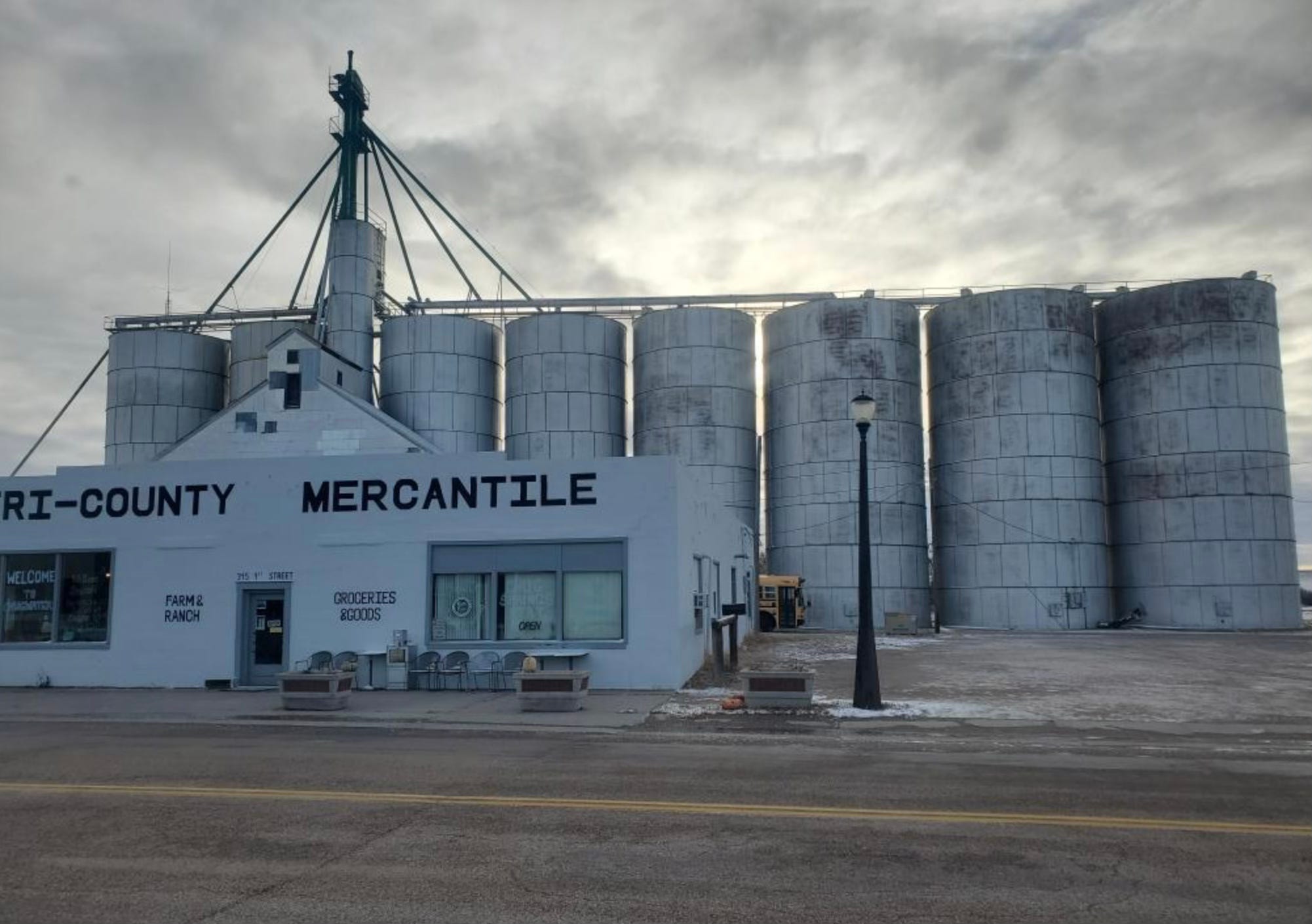
A row of towering steel silos stands in the center of our little town.
They’re remnants of another era, when dry land wheat farming was a major industry here and farmers would truck their harvests to town.
They’re empty now. The paint is peeling, the metal is rusting, and vultures like to sit on top and glare down at main street.
It’s poetic, in a haunting sort of way, I guess.
Sometimes I get so used to seeing the silos that I don’t see them at all—at least not until a customer at the soda fountain points them out and asks about them.
It’s easy to go blind to the things we see every day, even something as substantial as a steel tower. Everyday things weave themselves into the background of our lives until we no longer realize they’re actually there, even though they certainly are.
And once you start noticing that kind of blindness, you realize it’s not just about grain bins.
Because it’s not just our town that has silos.
Every town does. Every suburb. Every city.
This whole country is full of them, in fact.
But they’re not the grain-storing kind—they’re the mental kind. The ideological kind. The kind we build online and in our friend groups and in our churches and on our newsfeeds.
And instead of quietly emptying, these silos are getting taller, thicker, and louder.
Strangely enough, people can’t seem to see them, even though we’re living inside them.
I notice it the most when I try to talk about it online, like when I posted this a while back:
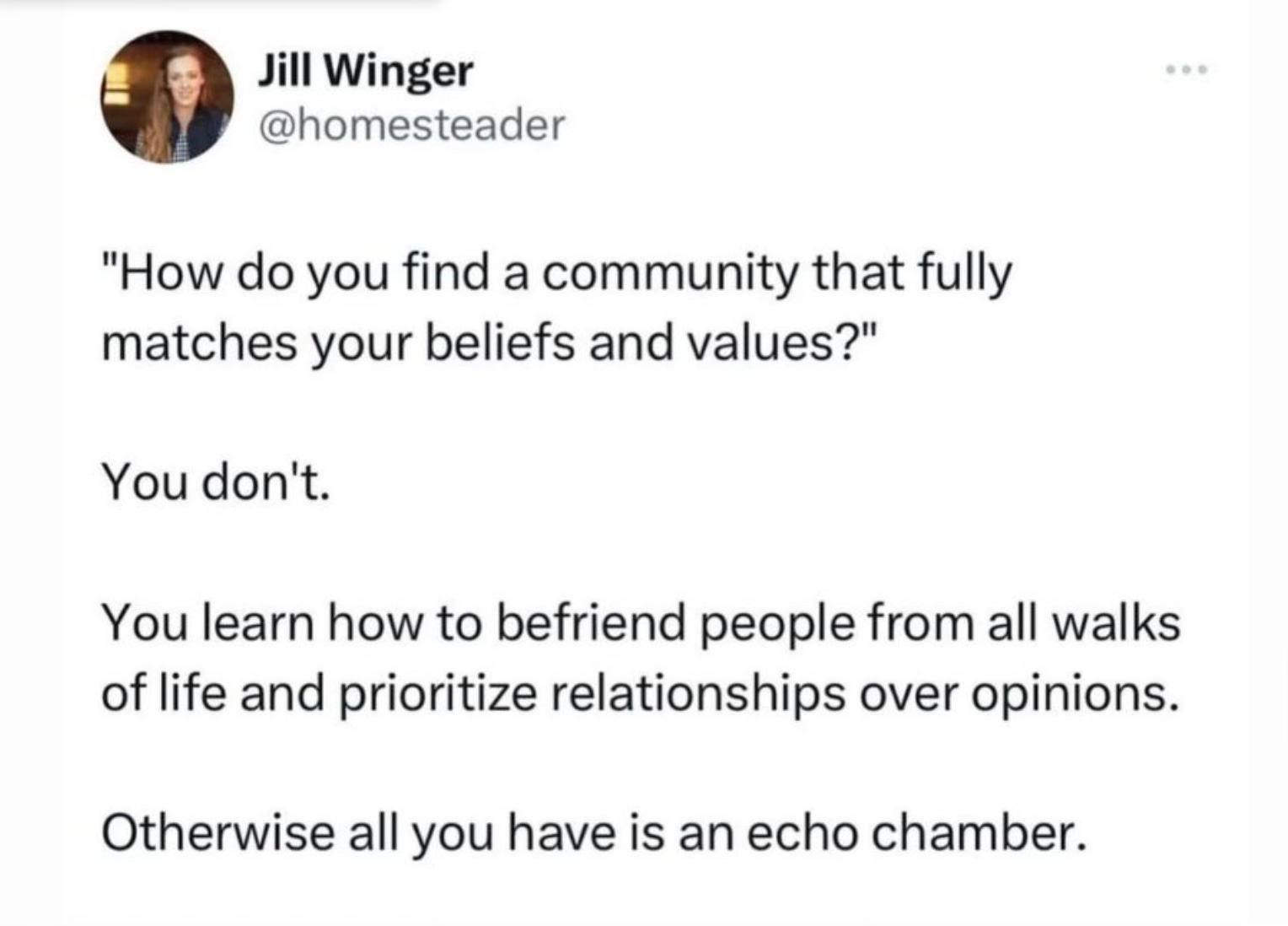
I thought it was a pretty benign, “kumbaya” sort of post… but the internet disagreed. What felt like a simple sentiment about togetherness to me looked like WAR to them.
Half of the comments said, “That’s fine, but NOT when it comes to people on the Left. Those people are dangerous. They’re destroying America and must be stopped.”
The other half said, “That’s fine, but NOT when it comes to people on the Right. Those people are dangerous. They’re destroying America and must be stopped.”
Sigh. Different jerseys. Same script.
But I’m not judging, because I, too, once lived in a silo.
Back then, I thought my silo was the greatest thing since sliced bread. It was strong and comforting and filled with people exactly like me. I loved the deliciousness of us vs. them. We KNEW we were right. We KNEW our cause was important. We KNEW better than to ask questions (because we already had the answers, of course). And we KNEW the other side was degenerate, evil, and must.be.stopped.
It was perfect, until it wasn’t. Until the day I ventured outside of my silo, and suddenly I realized my echo chamber wasn’t as special as I thought.
And now, after many years of untangling myself from siloed thinking, I choose to be silo-less.
Because of that, I now have the strange, uncomfortable privilege of dancing between the silos. I talk to some people here and some people there. I ask questions and listen to their stories. I see the passion in the eyes of both sides.
And my biggest takeaway?
They are shockingly the SAME.
Now, they do NOT like to hear that. In fact, it makes them furious.
“No, no, no! My side is correct! My side is saving America!” they say.
But once you strip away the branding, it’s the same arguments, the same justifications, the same “othering.”
Two sides of the same coin.
It’s fascinating. And it makes me realize living in a silo is mostly fruitless, even though, from the inside, it feels like you’re single-handedly saving the world.
So how do we exit the silos?
I’ve sat with that question for years.
I keep coming back to this: we have to notice the stories we’re being sold.
One of the biggest construction crews building these silos is our modern media ecosystem. And whenever I say that, people also get very angry. (Pretty much everything I say makes people angry, I guess…)
“You have to watch the news!” they say. “If you don’t, you’re not informed!”
But the reality is that so much of their precious “news” is scripted—on both sides. Both sides are selling you a story. Both sides profit when you’re convinced that alllll people on the other team want you gone. And before long, you’re repeating the same lines as the people you claim to despise—just with different colors on your team jersey.
Because that’s what so much of this is: a story. A narrative. A product. A revenue-producing machine.
They NEED us in our silos for their clickbait and shock strategies to work.
I could swap the words “Left” and “Right” in most of the comments I see online and no one would notice. It’s the same posture, the same fear, the same certainty that “those other people” are the problem.
It’s the division that’s dangerous.
And who is benefitting from all this chaos? It’s certainly not you. Or your neighbor.
So what do we do?
We fight back—but not with pitchforks and placards.
We fight back by listening. Which sounds soft and squishy, but actually feels a lot like resistance in 2026. True resistance. Resistance to the Machine as a whole—not just resistance to your opposing side.
We fight back by sitting at tables with people we don’t agree with and actually talking to them. Looking at their eyeballs. Asking real questions instead of loading our next argument.
We fight back by reading across the spectrum—not just the one outlet that tells us we’re right and everyone else is evil. We look for the people who are wrestling with ideas in the messy middle, not shouting from the extremes.
We fight back by making friends outside of our prescribed groups, outside our algorithms and favorite hashtags.
It’s easy to hang out only with people who think/feel/believe exactly like you. It’s safe. It’s comfortable.
But it turns us into sad, siloed hermits with a skewed perception of the world.
Which leads me to my other confession… the people who stay in their silos forever? I find them rather boring. You already know what they’ll say before they say it. Their stances, talking points, jabs, and jokes are premeditated and prescribed. It’s groupthink at its finest, and it feels numb and flat.
My most favorite people are the ones brave enough to stand in the middle of the road. The ones bold enough to ask their own questions. The ones adventurous enough to have thoughts of their own without the backup of a safe, warm silo full of people exactly like them.
The ones who can step outside their party line, their denomination, their club, and say, “Hold on… is this actually true? Does this still make sense?”
Those people light me up.
So no, I’m not saying silo-less living will be easy. It’s harder, for sure.
People are messy. Conversations get awkward. You will say the wrong thing. They will say the wrong thing.
But I am saying it’s worth it.
And it might just be the antidote we’re looking for. That is, if we actually want an antidote.
Because in the end, the answer isn’t Left. Or Right. Or higher, stronger silos.
The answer is very ordinary: talking to your neighbor. Bringing someone soup. Going to the school board meeting. Sitting around a table where the only algorithm is whoever happens to live within a 10-mile radius of you. In other words, the answer is stubbornly choosing to stay human.
That is how we start to chip away at the silos. That is how we resist.
So yes, the silos will always be there, looming at the edges of town.
But we don’t have to live in them.
– Jill
P.S. Inevitably, when I talk about this online, someone attempts to drops the mic with, “Well, I can’t have a conversation with someone who wants to hurt me.”
And sure—if someone literally wants to harm you, don’t have supper with them.
But I’d gently challenge that this, too, is mostly a media-fed story. In real life, most of the people you’ve been told would love to see you wiped off the map don’t actually feel that way—especially when they’re sitting eyeball-to-eyeball with you.
That line is just another thought-terminating cliché we’ve been sold to keep us in our silos. I dare you to question it.
It's so very true that living in a silo is mostly fruitless. I recently started making friends outside of my usual, core group, and found that I actually can make new connections - it's much easier than I thought.
I think this is a really important conversation and I appreciate you being willing to take fire from folks in order to write about it. It's easy to fall victim to siloed thinking. It's also becoming harder, I think, to articulate personal values without having to "choose a side". I have fallen prey to othering from time to time, but one thing that has helped guide me is a refusal to forsake the people I love. Even if my opinions and understanding have shifted, I trust the person I was when I brought that loved on into my life. If having a certain opinion requires me to cut people off, it's probably being influenced by an outside agenda. I think you've hit on an important point in highlighting that humanity and conncection can be a guiding light when we try to sift through the onslaught of news and information to get to the truth in the messy middle.